Sunday, March 20, 2011

The Old Woman Who Lived in a Vinegar Bottle

Written By: Rumer Godden
Illustrated By: Mairi Hedderwick


If I Had A Wish...

If I had a wish, I would wish for a car
And then when I wanted, I could go really far
If I had a wish, I would wish for money
And then I'd do what I want, no matter the fee
If I had a wish, I would wish for a house
I'd have chairs and a couch, maybe even a mouse!
If I had a wish, I would wish for it all
But then, should I wonder what bad could befall?
I would have what I want, and want even more
I'd become greedy and full, of that I am sure
If I had a wish, I would wish for a dream
In a world full of love, in a place I could sing
Where all would be well and my life I'd enjoy
Without fortune and fame, greedy and coy
But wait, what is that I hear myself say?
I do have that dream, I live it today.
I have family and friends, a good home and money
I'm as happy and well as I ever will be.
The truth I must share with you I say
If I had a wish, I'd wish for today.


A Handful of Time

Written By: Kit Pearson


If ever a novel could make me feel so depressed yet so empowered at the very same time, it would be Kit Pearson's novel A Handful of Time. After reading the novel, I felt as though somebody had taken the very intimate details of my life and used them against me, like a slap in the face. However, when I first started reading the novel, I felt such a special personal connection to the main character of Patricia. Patricia was described as a young, painfully shy and nervous girl who was spending the summer at her family's lake. The reason for doing so was because her parents were working out the details of their separation. Even though the situation was portrayed differently, I still connected to Patricia in the sense that I too, dealt with the divorce of my parents at a young age. Likewise, I spent most of my childhood summers at my grandparent's house and therefore I felt a sense of empathy for Patricia. I was also a painfully shy little girl and so I saw myself reflected in the character of Patricia. As Patricia travelled back in time and the details of her mother's past were revealed, I felt such a sickening sense in the pit of my stomach. As I read further, memories of my own past, reflected in the character of Patricia's mother Ruth, came flooding back at me. Like Ruth, I was treated completely different from anyone else in my family. Due to unfortunate circumstances, I constantly felt alienated, rejected and out of place at "home." Because I was so different from my family in way of thoughts, beliefs and actions, I was consistently accused of thinking that I was better than everyone else. Even though Ruth's life experiences were not as extreme as mine were, reading about her alienation from her family made me depressed for remembering long forgotten woes. But, reading about how Ruth created an independent life for herself, one that was quite successful, gave me a sense of peace. I thought about how I came out on top despite the adversary in my life. I maintained extremely high marks throughout school, made a positive reputation for myself in the community and moved out on my own at age eighteen. Reading the sentence "Sometimes it might be best to forget the past or at least accept it, and then keep on going" empowered me. That sentence reflects the strength and power I see in myself today. A Handful of Time allowed me to reflect on my accomplishments as an individual. I thought about how I put the past behind me a long time ago and I am proud of the life I have created for myself. I have the most wonderful and understanding relationship with both my mother and my brother today and the woes of the past have been long forgiven. A Handful of Time reminded me of my own life struggle, but one in which I proudly overcame.

Storytelling Style
The description of a sad and lonely girl, confused by the details of her parent's separation enabled an effective transition into an altered reality. Feelings as such coupled with anxiety over spending the summer with a family not well known, makes it easy for a reader to suspend disbelief when Patricia travels back in time. Patricia is a believable character with whom readers can relate to. Patricia is forced to spend the summer at a lake, an environment she is not used to. Her cousins tease and make fun of her and all the while Patricia is dealing with feelings of confusion over her parent's separation. Patricia's experiences and feelings are those of which some individuals are familiar with. Therefore, seeing the story from Patricia's point of view enables the reader to believe the story as if it could possibly be true. Also enabling the reader to view the story as true, the setting is described in deep and thorough details. The images are described so in-depth that one can imagine oneself lying upon the cool bed at La Petite or running over the hot sand at the beach.

The Main Character
The growth development shown in Patricia throughout the course of the novel allows readers to suspend their disbelief of the modern fantasy. Readers believe the story to be true because it is not just a story about a girl travelling back in time, it is the story of a girl who learns the truth of her mother's past and is enabled to create her own future. Patricia is first presented as a shy young girl who bottles her emotions and is teased and taunted by her cousins. By the end of the novel, Patricia realizes the potential in herself, sharing her thoughts and feelings with her mother and sharing her talent of cooking with the entire family. As readers see how Patricia develops over time from a painfully shy child to a more confident young lady, the story of travelling back in time into a distant past is made believable.

A Handful of Time forced me to realize that I will truly never regret the unwanted memories of my past and enabled me to realize the beauty of my future.


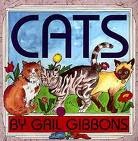
Cats

Written By Gail Gibbons


While editing my reading response journals, I felt as though I had to re-write my journal response to the information book Cats, written by Gail Gibbons. I felt as though I had written the journal response in a more educational manner as opposed to a more reflective, personal manner. As I prepared to write another journal response, I felt as though some main points were valuable and so should be included in a revised edit of the first journal response. These important points included:

  • Cats is an effective information book for readers because the content is accurate and true to the subject area.
  • The reader is offered a vast array of information pertaining to the history, characteristics and care of cats and kittens, thereby broadening their horizons on a familiar topic.
  • The book fosters a reader's development of critical thinking and reading skills. A combination of short and long sentences are used to create a sense of steady flow when reading. Also, the diction used is quite simple so that readers are not over-complicated by the vast array of information provided.
  • The illustrations are accurate and enrich the text by providing a visual image relating to the information provided in any particular section. The illustrations are not incredibly vibrant nor completely dull but contain recurring colors of green, brown, some red and blue- mainly neutral colors. Because Cats is not an exciting story, a suspenseful mystery or an imaginative creation, the neutrality of the illustrations connect and unify the informative text.
  • Most important of all, Cats is an enjoyable read.
I sat down to re-read the informational book Cats and about half-way through, I had to stop reading. When I reflected originally on Cats, I had talked about how the book made me think of my own three cats and how much I loved them. Unfortunately, between the time that I wrote my first journal response and then my second journal response, my cat Meeko went missing. Meeko was twelve years old; a very old cat. Even though it is painful to think about, I believe that Meeko knew his time was short and so he left to pass away. After a sad moment, I convinced myself to continue writing my journal response, in specifically responding to the section entitled "Caring For Your Cat." I immediately thought of how I had adopted Meeko and his sister Miyou when they were ten years old. I remember Miyou's big green eyes and how she was scared all the time. It took lots of love, care and patience to gain her trust and in time she became a very contented, very loving old cat. Meeko was not very affectionate at all and appeared quite small for his age. With lots of love and care and a huge dent in our cat food budget, Meeko became the very definition of a lazy, cuddly lap cat. He was fat, but healthy. As I read further on in the book, I felt such a pure sense of happiness and pride because I knew I had essentially saved my cats and given them a good, happy home. I realized that no matter how sad I was over losing Meeko, I was happy too because I alone had made him into a happy and healthy cat who could have no better. Reading the section on "Caring For Your Kitten" made me smile as I remembered bringing home my kitten, Monster. Reading the book Cats was made meaningful and engaging to me as I reflected on my role as a good pet owner- and most importantly, made peace with the absence of Meeko in my life.


Saturday, March 5, 2011

Dinosaur Dinner (With A Slice of Alligator Pie)

Favorite Poems by Dennis Lee
Selected by Jack Prelutsky
Illustrated by Debbie Tilley

"To foster creativity in children, we must first find it within ourselves"

Dinosaur Dinner (With A Slice of Alligator Pie) is a selection of short, silly, rhyming poems. Each poem is effectively accompanied with a cartoon drawing, creating a complementing visual image to the text. What I liked most about this book was in fact, the title! I remember reading the poem Alligator Pie when I was in elementary school and absolutely loving the rhyming scheme associated with the poem. Everytime I say the poem in my mind, I do so with an exaggerated tone of expression, emphasizing words in some phrases and changing the volume of my voice for others. I think that when children are presented with fun, silly and simple poems, they are enabled a personal connection with that poem because it is something that is exciting and appealing to them. When children find a personal connection with poetry then a love of poetry is fostered.  When I was a teenager, I used poetry as a means to convey my personal thoughts and emotions. However, unlike Dinosaur Dinner (With A Slice of Alligator Pie), my poems tended to be sappy and sweet, thoughtful and sad.  Reading this particular book inspired me to pick up my pen, pull on my thinking hat and give a go at the poetry skills again-this time with a new twist! I believe that in order to foster creativity in children, we must first find creativity within ourselves.

Vanilla chocolate cake, vanilla chocolate cake
 I eat too much, it gives a toothache.
I eat a piece of light, then I eat a piece of dark
I can't get enough of vanilla chocolate cake

Vanilla chocolate cake, vanilla chocolate cake
It's goodness is so yummy, I simply cannot wait
Moist, soft and great. Sugar coated sweet
Gimme some o'that vanilla chocolate cake


Dinosaur Dan, Dinosaur Dan
My bestest friend, he's cool, wild and down
A trickster too, he's fun to be around
Dinosaur Dan, oh Dinosaur Dan


Peter, Tom and Polly, Peter, Tom and Polly
They had a sister and her name was Molly
They liked to jump around, outside the skirts of town
Oh how I miss silly Peter, Tom and Polly


Quincy Rumpel

Written by Betty Waterton

From a spaghetti surprise to a mushroom business; from a hair-do experiment to an attic disaster, the Rumpel family are zany and crazy and never seem to skip a beat! Quincy Rumpel is the story of a fun-loving family's move to the West Coast and the exciting events of which to follow.

Personal Feelings
I thought Quincy Rumpel was the most silliest, innocent and fun-loving book I have ever read. When I read of Quincy's marvellous plan to cut her own hair (you can imagine how that one went!), I thought about my own hair-cutting fiasco. Best friend. Curly hair. Sticky gum. You get the picture. When I read about how Quincy fell from the attic through her parent's ceiling, I thought of my own attic catastrophe. Clumsy best friend. Small attic. Dust and plaster. It's self-explanatory really. While reading Quincy Rumpel, I thought of how as a child I dreamed of belonging to a family just as exciting as the Rumpel family. I felt that same kind of enthusiasm and excitement over imagining myself a part of such a dysfunctional, crazy, fun family, just like the one portrayed in Quincy Rumpel. Quincy Rumpel delighted me to no end and transformed me into a silly world of which I became a part of.

Reflection
Reflecting on my childhood desires to belong to a family like the Rumpels, enabled me to reminisce about memories of the past from an adult perspective. Most of my happy childhood memories stem from time spent with my grandparents and extended family out around the bay. What Quincy Rumpel did for me was to remember those long forgotten but nevertheless, precious memories. I remember how my aunt and I performed a puppet play for my little cousins using faces drawn on socks, behind an old mattress. My grandmother and grandfather were laughing so hard they almost fell off the chair. I remember how my grandfather had a little bit of cake stuck to his lip, and how Nan and I spent the entire afternoon laughing at him. Quincy Rumpel made me realize that even though I longed to be part of a different family as a child, I had always and always will continue to believe that my extended family could not replace another.

Plot
Quincy Rumpel is such a delightful novel for young readers because it is funny, witty and upbeat. The novel follows a family of five who move to the West Coast to support Mr. Rumpel's mushroom business. The storyline is told in a series of outrageous events which are undoubtedly humorous. The mood conveyed throughout the novel is positive and upbeat even despite a few "ordinary" catastrophes. For example, it is quite hard not to laugh when one reads how Quincy jumps on her brother for lying on her balcony, her glasses fly off her face and the entire family searches for the glasses in the bush. This excitement occurs only hours upon purchasing the glasses. In the novel, events are quick to happen and just as quickly to be resolved with problems always presented in a fun and silly manner. In doing so, the novel is presented as an easy read for less advanced readers. The one story outline divided into short chapters allows for a more comprehensive understanding of one idea. The novel's theme is reflected in the togetherness of family and friendship and enables in readers a sense of hope and happiness.

The Main Character
Quincy Rumpel is young, curious and full of life. The lack of character development avoids confusion in young readers and enables one to relate to and connect with a stable character. Young females in particular, can relate to the charming attributes of a fun-loving girl. Quincy Rumpel's thoughts, feelings and actions reflect what children see in themselves and/or are curious to recognize in others. For example, Quincy cuts her own hair when it becomes too long, is caught at two in the morning trying to find a Save the Whales t-shirt, and tries to convince her parents that they truly need a dog in the family. Quincy is impulsive, unpredictable and treats life like one big adventure. In this way, readers can relate to a character like Quincy, someone who is effective as a believable character.

The Book Connected to the Real World
After reading Quincy Rumpel, I thought about how I ought to appreciate each day of life in its entirety and to not stress over the small things. I thought about how I tend to become overwhelmed and caught up in everyday occurrences which cause me great anxiety and grief. What I took away from Quincy Rumpel was a greater appreciation for life. The next time I'm moody and upset about not having a supper hour because I work, I'll remember Quincy's determined attempt at a half-frozen, half-edible spaghetti surprise. When I stress over getting schoolwork completed in time, I'll think of the Rumpel family's happy-go-lucky attitide. Quincy Rumpel reminded me that life is full of problems- big and small but that it is our attitiudes and reactions to those problems which allow us to enjoy the life we are given.

Thank You, Mr. Falker

Written and Illustrated by Patricia Polacco


"The honey is sweet, and so is knowledge, but knowledge is like the bee who made the honey, it has to be chased through the pages of a book."

Thank You, Mr. Falker, is an autobiographical narrative of Patricia Polacco's personal struggle with dyslexia in primary and elementary school. In Thank You, Mr. Falker, a kind-hearted fifth grade teacher discovers that Trisha cannot read, and so with determination sets out to help her do just so- and she does. Thank You, Mr. Falker is a personal thank-you to a teacher who truly cared and to all teachers alike who continue to change the lives of children.

Storytelling Style
Patricia Polacco's personal struggle with dyslexia is told through the eyes of young Trisha in a poignant and reflective manner. The storytelling style is quite effective as the narrative begins with a sense of hopefulness in the promise of a young girl learning to read. As the story of Trisha's struggle with reading and mathematics unfolds, the setting and events which are to follow allow children to relate to the main character. Just as Trisha had felt despair in her struggle with learning to read and was ridiculed and teased by fellow classmates, readers can relate to negative feelings expressed as a result of difficulties in school. A sense of hope and promise is instilled in readers when Trisha finally learns how to read, with the help of one special teacher.

The Main Character
The main character, Trisha, is a believable character whom children can relate to. Trisha is described as a young girl who loves school because it is a place where she can express herself through art. Trisha's weakness is reading and as a result, is teased and ridiculed by her peers because she lags behind in reading development. Trisha literally hides herself away from the cruelness of her peers until she meets one truly special teacher, Mr. Falker. Mr. Falker does everything in his power to help Trisha learn to read and she does, resulting in great pride. Children can relate to Trisha's character in the sense that they experience most, if not all of what Trisha experiences in the narrative. Children can relate to being in a school setting where teasing, fear and loneliness is present and can therefore feel empathy for Trisha when she is ridiculed by her peers. Children can also relate to the relationship shared by Trisha and Mr. Falker in the one person that they look up to- their hero.

Illustrations
Polacco's illustrations were created using either acrylic paint or oil pastels which give the images a textured look. The colors often run one into the other, which focuses and highlights areas of lightness and areas of darkness. Most effectively, Polacco uses color to convey mood from the text. For example, when Polacco speaks of Trisha's grandmother and grandfather letting go of the grass and passing on, dark green colors are used to reflect a somber mood. When Polacco described how Trisha and her family moved across country, Polacco used bright orange to convey the mood of enthusiasm and happiness. The illustrations therefore give effective meaning to the text.

Personal Feelings
After reading Thank You, Mr. Falker, I felt a sense of admiration for all the compassionate teachers who made a difference in a child's life. The book enabled me to reflect on my own experiences in school and to think of all the wonderful teachers who I believe represent Mr. Falker. I thought about how I related to the character of Trisha in the sense that we both struggled with aspects of school; for Trisha, it was the curriculum, for me it was a struggle with feeling like an outcast. I had plenty of friends and always someone to talk to but I was different. I grew up in a broken home in a social housing development with my mom and brother. I connected to Trisha in feelings of loneliness and thoughts of being a failure. I felt empathy for Trisha. Yet, the book inspired me and gave me a sense of hope in knowing that my plans in life were true- to one day become a remarkable teacher like Mr.Falker. Reading Thank You, Mr. Falker was like looking into a window of memory and having my own image reflected back. I thought about those teachers, who like Mr. Falker, never gave up on me. The teachers who took me for face value and did not just look at my family life or situation. The teachers who did not judge me for what I came from but who challenged me for what I would become. Thank You, Mr. Falker did more than just instill in me a sense of happiness and contentment, Thank You, Mr. Falker made me forget about the stresses and anxieties of life and allowed me to truly reflect on my one true purpose in life- to teach.